From The Book of Mormon and Chicago to Pup!: Broadway Influences in Local Theatre
Broadway technique does not become community theatre by getting smaller. It becomes useful when the production team decides which theatrical forces belong in the room and which ones should stay in Times Square. In an adoption-centered musical event, that distinction matters because the principal performer may be a dog who has never heard applause before.
The better question, then, is not whether local theatre can imitate a hit musical. The better question is whether it can borrow the architecture of a hit musical and use it to change how an audience sees a shelter animal.
The Theatrical Hook: Merging Spectacle with Rescue
Can spectacle change an adoption outcome?
Can high-end theatrical production values directly impact animal rescue outcomes? The question sounds almost too bright for a field usually shaped by intake forms, foster notes, and anxious first meetings. Yet the stage has one advantage that a folding table in a lobby rarely gets: it can control attention.
Traditional adoption events often carry a somber undertone. The dogs are deserving, the need is urgent, and the room asks visitors to act from compassion before they have formed a relationship. Musical theatre reverses that order. It asks the audience to watch, listen, laugh, and only then recognize that affection has already begun.
Pup! A Chew Story works from that reversal. The framing decision begins with the adoption journey rather than with the songs: arrival, first impression, foster backstory, audience connection, and post-show inquiry are treated as musical beats. The structure gives the dog an entrance, a context, and a reason to be remembered.
From lobby sympathy to theatrical attention
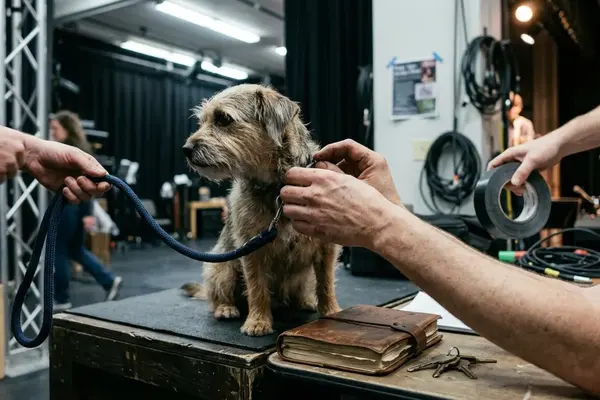
The practical criteria are plain. Dog-and-handler arrival is best scheduled about an hour to 75 minutes before the house opens, which leaves time for decompression, leash checks, water, and a quiet walk-through of the entrance path. The adoption information station belongs outside the main performance traffic lane and should remain staffed from roughly half an hour before curtain until 45 minutes after the final bow.
Individual dog moments stay strongest when they are brief. A minute-or-so appearance gives personality enough room to register without asking an animal to hold a pose like a trained theatrical statue. That is where spectacle becomes ethical: it frames the moment, then gets out of the dog’s way.
Bottom Line: The show does not ask rescue work to become glossier. It asks theatrical craft to make the existing adoption journey more legible, more joyful, and easier to act on.
Choreographic Storytelling: The Chicago Influence
Vaudeville as a modular engine
The influence of Chicago is not simply fishnets, chairs, and a raised eyebrow. Its deeper usefulness lies in the vaudeville-style vignette structure, where each number can operate like a self-contained argument. That modular form suits an adoption event because every dog needs a distinct theatrical frame rather than a place inside one continuous plot.
The history of vaudeville narrative structures helps explain why the approach travels well. Short turns, clear character types, and immediate audience recognition allow a production to introduce a performer quickly. In this context, the performer may be a senior terrier with couch manners, a young hound learning leash confidence, or a shy dog who appears by narration rather than a live entrance.
Fosse detail, canine readability
The choreography functions as punctuation, not decoration. Long dance phrases built around dogs tend to put pressure on the least predictable body in the room. Short, legible human movement motifs can instead frame what the dog naturally offers: a glance, a sit, a curious pause, a confident trot toward the handler.
Fosse-inspired detail translates most safely through the human ensemble. Angled wrists, shoulder isolations, chair silhouettes, and tight formation changes can sit several feet from the dog’s walking path. The dog’s route should remain simpler: entrance point, pause point, exit point. Three landmarks give the handler clarity without forcing the animal into a count sheet.
Rehearsal has to honor that same economy. A practical pattern uses two short animal calls per dog, each running about a quarter of an hour, separated by at least 20 minutes of rest away from speakers and foot traffic. The ensemble may crave repetition; the dog usually benefits from recognition, release, and quiet.
Field Note: Sharp choreography elevates the perceived value of the rescue dog when it makes the human performers look disciplined and the animal look unforced. The dog becomes the star, not the prop.
Satire and Sincerity: Echoes of The Book of Mormon
The buddy-comedy contract
The Book of Mormon popularized a modern buddy-comedy rhythm that pairs innocence, ego, confusion, and devotion inside one combustible duet. Applied carefully, that rhythm suits human-canine stage relationships. The human performer can be overeager, vain, or hilariously earnest; the dog can remain truthful by doing very little.
This contrast matters because comedy gives the audience permission to relax before the production asks them to care. A dog who ignores an obvious cue is not a mistake if the number has been built around human recovery. The performer kneels, offers a treat cue, misses the dog’s signal, narrates the reaction in real time, and lets the room laugh with recognition rather than at the animal.
Where the joke hands off to welfare
Satire carries risk when the subject is rescue. If the joke lands on the animal’s hardship, the room tightens. If the joke lands on human self-importance, romantic fantasy, or theatrical over-preparation, the dog remains protected while the audience stays open.
That is the useful lesson from irreverent musical comedy: sincerity can arrive after laughter without sounding sentimental. Welfare information lands better when it attaches to concrete behavior. A lyric about crate comfort, tolerance for city noise, couch manners, or leash confidence gives the audience a usable memory. A lyric that only insists a dog is lovable may feel warm in the moment, then blur by intermission.
The pacing target is equally specific. The most direct adoption appeal belongs after a laugh-heavy number, when the room has relaxed and the dog has been seen as a personality rather than a problem to solve. The comic frame disarms defensiveness; the sincere appeal gives the audience somewhere to place its affection.
Important: Irreverence should never make the dog responsible for carrying the joke. The safer comic engine is the human character’s misreading, overreaction, or theatrical fuss.
Production Limitations: Scaling Broadway for Live Animals
The mega-musical must yield
Broadway scale promises control: automated scenery, exact light cues, thunderous sound, and dancers who hit the same mark eight times a week. Community rescue theatre begins somewhere else. The production choices are made by working backward from animal comfort, then allowing theatricality to fill the remaining space.
That order solves more problems than it creates. Live sound should be checked with handlers present, and vocal reinforcement should favor even coverage over volume. Sudden sound cues, whistle effects, and sharp percussive hits are poor fits for shelter-dog staging. A thrilling button for the orchestra can become a startle event for an animal still processing lobby scent and moving costumes.
Designing the off-ramp
Set pieces near dog traffic need to be weighted, low-glare, and free of dangling fabric. Rolling units need locked casters before any animal enters the playing area. These choices may feel modest beside a touring spectacle, but they create the condition that lets the audience see ease rather than management.
The cueing system also has to be humane. If a dog stops, sniffs, shakes off, or turns back toward the handler, the music can continue under dialogue instead of forcing the next choreographic beat. The scene bends; the animal does not.
One failure case deserves sober attention: a dog that rehearses calmly in an empty room may become overwhelmed when applause, lobby scent, and moving costumes arrive together. The show needs a non-punitive off-ramp for every animal entrance. That off-ramp may be a handler exit, a narrated substitute, a video insert, or a foster testimonial delivered in place of the planned walk-on.
Scale also changes the solution. A black-box theatre can use close-up storytelling and acoustic underscoring. A larger civic auditorium may need projected dog profiles, wider handler paths, and stricter backstage traffic control. The model is best suited to dogs already cleared by rescue staff for public handling, moderate noise, and brief contact with unfamiliar people; highly fearful or medically fragile animals are better represented through video, narration, or a foster voice.
Field Note: The production is not less theatrical because it compromises. It is more precise because every cue answers to the living performer with the least control over the room.
The Transformative Power of Performance in Adoption
From pity to celebration
The closing argument is built around celebration because pity can make an audience freeze. Story gives the audience something to do. By giving each dog a theatrical identity, the event reframes adoption as recognition rather than rescue fantasy.
Narrative transportation offers a useful academic vocabulary for what theatre workers already notice in the house. When spectators follow a character through a sequence of feeling, they often hold that character in memory with more texture than they would retain from a direct appeal alone. In an adoption setting, that texture matters: the dog is not merely available; the dog has entered, paused, reacted, and belonged to a scene.
The action after the final bow
The performance cannot carry the work alone. Post-show action should be immediate and simple: visible adoption-interest forms, foster sign-up cards, QR codes near the exit, and a staff member assigned to answer temperament and home-fit questions. The path from emotion to inquiry should be shorter than the walk to the parking lot.
Follow-up is strongest within a day or two, while the remembered stage moment is still fresh and before routine distractions replace the emotional connection. The archive should support that memory with more than glamour photos. Useful records include dog name, foster notes, preferred household conditions, the song or scene featured, and whether the dog appeared live, by video, or through narration.
Critical review reveals a final comparison. The Broadway hit often transforms an unknown performer into a name the audience repeats on the way home. An arts-integrated adoption event can do a quieter version of that same work for a rescue dog. It gives the animal a cue, a frame, and a moment of collective attention.
That is not a guarantee of adoption, and it should not pretend to be. It is a disciplined change in presentation: less pleading, more encounter; less spectacle for its own sake, more theatrical hospitality. Local theatre may never reproduce the machinery of a Broadway house, but it can reproduce the deeper magic: a roomful of strangers agreeing, for a few bright minutes, that one living creature is worth watching closely.