“When you write a dog singing, what are you refusing to let that dog say?” That question sits at the center of Pup! A Chew Story, not as a clever rehearsal-room provocation, but as a practical guardrail. A shelter dog onstage can invite laughter, ache, recognition, and tenderness. The harder task is preventing that dog from becoming a person in fur.
The musical’s creative structure places that problem in three hands: Marcus Terrell Smith shapes the book and lyric architecture, Robin Schäfer carries harmonic and emotional design, and Christopher C. Sargent builds orchestral color into narrative information. Their work is academic in its discipline and theatrical in its appetite. The result has to hold two facts at once: abandonment is heavy, and musical comedy still needs lift.

The Theoretical Challenge of Anthropomorphic Storytelling
The dog cannot become a person in fur
The first dramaturgical challenge is theoretical before it is sentimental. How can musical theatre authentically represent the psychological state of a shelter animal without devolving into caricature?
A weaker version of this premise would turn dog characters into joke machines with human punchlines. That approach might earn quick laughs, especially from audiences trained by sharp post-Book of Mormon musical comedy rhythms, but it would make abandonment feel decorative rather than central. The better question is not whether a dog can sing. In musical theatre, nearly anything can sing. The stricter question is what the song is allowed to know.
The kennel gives the production its first set of rules. It is a place of compressed sound and waiting: gates, footsteps, sudden noise, nearby breath, the repeated possibility that someone may stop. The adoption floor changes the grammar. Tempo, lighting, and ensemble movement open outward. The animal is not suddenly cured, but the stage begins to offer space.
Important: The production’s emotional credibility depends on restraint. If every animal thought is explained in human language, the audience stops watching behavior and starts listening for punchlines.
Three theatrical functions
The creative triad matters because anthropomorphic storytelling fails when one craft discipline does all the explaining. Smith’s libretto can define what a dog wants, but it cannot narrate every tremor. Schäfer’s harmonic language can carry anxiety where the book withholds literal explanation. Sargent’s orchestration can mark difference among animal characters without crowding the stage picture.
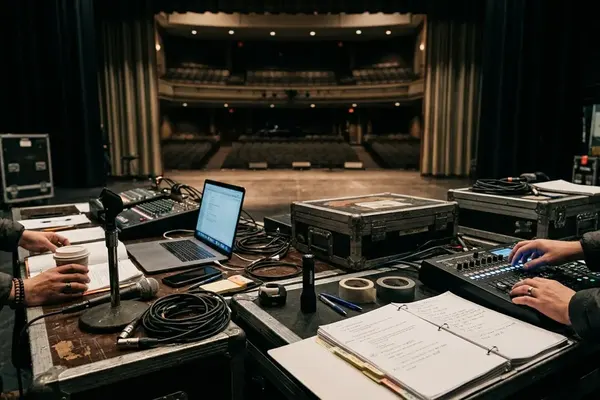
Critical review reveals a useful comparison: in realistic drama, silence often carries interior life; in musical comedy, silence must compete with rhythm, movement, and audience expectation. Pup! A Chew Story therefore needs a disciplined system for absence. The team must decide where information is removed, not merely where feeling is added. Within the limits of stage translation, that is the project’s most serious act of advocacy.
Structuring the Narrative Voice: Marcus Terrell Smith
A libretto-first investigation
Marcus Terrell Smith’s contribution to book, lyrics, and arrangements begins with actor training rather than animal mimicry. His process can be read as a libretto-first investigation shaped by the practical questions of performance: What is the animal’s objective? What is the obstacle? What sensory trigger arrives right now?
That structure connects naturally to training at the Actors Studio Drama School at Pace University, where playable action matters more than decorative emotion. The dog does not sing “I feel abandoned” because that line resolves the scene too quickly. A more rigorous lyric begins from a visible action: pawing at the kennel gate, turning away from eye contact, circling before settling, freezing at sudden noise, or leaning into a handler’s leg.
The method is almost clerical, and that is its strength.
From behavior to rhyme
Smith’s useful lyric pass can be imagined in three layers. One column holds the dog’s visible action. A second column records the human audience’s likely interpretation. A third column searches for the lyric that avoids overexplaining the feeling.
- Observed behavior: a dog freezes when a metal sound cuts through the kennel.
- Audience interpretation: fear, memory, or sensory overload.
- Playable lyric choice: a clipped phrase with repeated consonants that makes anxiety legible before the orchestra enters.
This is where craft rescues compassion from softness. A repeated consonant can tighten the mouth. A short vowel can refuse breath. A rhyme can land too soon and feel trapped, or arrive late and feel like relief. Smith’s task is not to make the dog eloquent in a human way. It is to give the performer something playable while leaving the animal’s interior life partly protected.
Field Note: The strongest interview question for a writer in this position is not “What does the dog mean?” It is “Where did you remove information so the audience would keep watching the body?”
The solution is formal rather than cute. The libretto invites empathy by narrowing speech, not expanding it.
Harmonic Progression and Emotional Arcs: Robin Schäfer
When the score carries the weather
Robin Schäfer’s role in music and arrangements becomes clearest when the book deliberately refuses explanation. If Smith’s lyric decides what the animal cannot say, Schäfer’s harmony decides what the room cannot hide.
His 2018 transition to full-time composition provides a useful dated pivot, not as a trophy line, but as context for the kind of sustained musical thinking the score requires. The shelter environment asks for unsettled harmony: suspended chords, unresolved dominant motion, ostinato figures, and phrase endings that avoid full cadences. These choices do not “mean” fear in a fixed code. They create a condition where rest keeps being deferred.
The adoption material moves differently. Warmer arrival points begin to appear through longer melodic lines, steadier bass motion, and cadences that finally let the singer breathe at the end of a phrase. The emotional arc is therefore not simply sad-to-happy. It is constricted-to-breathing.
The point where harmony stops pacing
The central interview prompt for Schäfer is precise: “Where in the score does the harmony first stop pacing?”
That question avoids vague praise. It asks for location, function, and consequence. A shelter scene may use an ostinato because the animal cannot settle; a later reprise may release the same figure into a broader phrase because the animal has found a new relationship to the room. The motif remains recognizable, but its pressure changes.
Iterations demonstrate one important correction in the team’s musical vocabulary. A more cartoon-bright sound for animal characters was tested, then abandoned because it made the shelter stakes feel too thin. This is the article’s clearest problem-then-solution case: brightness alone gave the show energy, but not moral weight. The revised approach allows comedy to enter through timing and character contrast while the harmonic field keeps the abandonment theme present.
The collaborative demand is delicate. Contemporary musical theatre gives the score rhythmic immediacy. Classical thematic development gives it memory. Schäfer’s work sits between the two, making sure the audience can enjoy forward motion without forgetting what the animals are carrying.
Developing Orchestral Texture: Christopher C. Sargent
Color without clutter
Christopher C. Sargent’s orchestration and arrangement work answers a different question: how can character identity be heard without making the stage picture busier?
His 2020 Jeff Awards sweep for An American in Paris gives useful context for his orchestration pedigree, especially because this production requires elegance under constraint. The job is not merely to make the score sound fuller. It is to assign enough instrumental identity that animal characters register as distinct, while keeping lyrics, movement, and handler relationships clear.
The colors can be described through ranges rather than gimmicks. Low reeds or cello can suggest guardedness. Pizzicato strings can capture quick scanning energy. Brushed percussion can keep nervous motion alive beneath dialogue. Warm woodwinds can support trust-building moments without smothering them.
Scaling the score for live theatre

The technical question is practical: how does Sargent thin the orchestration under lyric-heavy exposition, then restore instrumental color during transitions or reprises?
That is not a minor adjustment. A live theatrical arrangement must survive rehearsal-room piano reduction, staged movement, and final ensemble balance. If the dog’s motif only works in its fullest orchestral clothing, it is fragile. If it still reads on piano and percussion in a small black-box staging, then a larger Los Angeles presentation can expand the same idea through woodwind color, string texture, and choreographed ensemble traffic.
This is where comparison clarifies the craft. A film score can move close to the animal’s face and flood the soundtrack with interiority. A stage score has to share air with bodies, leashes, sightlines, laughter, and applause. Sargent’s orchestration must therefore be legible at several distances. It has to guide attention without pointing at itself.
Bottom Line: Orchestration in this musical functions as narrative color. It tells the audience where to place emotional attention, but it leaves room for the performer and animal-handling vocabulary to complete the moment.
Scope and Limitations: The Boundaries of Advocacy Theatre
Artistic standards and real-world cause
Advocacy theatre carries a built-in risk. If the cause overwhelms the art, the evening can become instruction with songs attached. If the art detaches from the cause, the shelter animals become atmosphere.
Pup! A Chew Story works inside that tension. The production can lower emotional distance, create a memorable adoption atmosphere, and help audiences imagine an animal’s interior life with more patience. It can also maintain high artistic standards within the Los Angeles critical culture associated with institutions such as the LADCC. Those pressures should be treated as parallel, not as proof of each other. Recognition does not guarantee adoption impact, and advocacy purpose does not excuse weak theatrical construction.
The better frame is responsibility. The show invites feeling, then refuses to complete the real-world decision inside the fiction.
What the show should never simplify
The final interview prompt for the creative team is not promotional: “What part of adoption should the show never try to simplify?”
The answer must remain specific to the medium. A musical can intensify empathy in the room, but actual adoption decisions still depend on household readiness, animal temperament, and the shelter’s matching process. That catch is not a retreat from advocacy. It is what keeps the advocacy honest.
The strongest closing image is therefore not a curtain-call miracle in which every feeling becomes a finished outcome. It is quieter. An audience leaves the performance with an animal’s story in mind, then encounters adoption information, volunteer options, or shelter partner materials outside the dramatic frame. The show has done its theatrical work. The shelter process begins where the applause ends.
That boundary gives the creative team room to keep evolving the project. Smith can refine the withheld lyric. Schäfer can locate the place where harmony stops pacing. Sargent can adjust color so the animal’s motif survives both intimate and larger stagings. The medium cannot do everything, and it should not pretend otherwise. Its gift is more particular: for a few hours, it can make waiting audible, make trust visible, and make compassion feel like an action rather than an idea.