Contents
- Loud Cues, Crowded Crossings, and a Dog's Instinct to Leave
- Why Exact Marks Fray in an Adoption Musical
- The Quiet Room as Company Boundary
- Separating Harmonies From Handler Passes
- Approve the Dog-Free Version First
Loud Cues, Crowded Crossings, and a Dog's Instinct to Leave
Standard musical theatre rehearsals demand intense repetition, high volume, and strict blocking. Those three habits collide with a rescue dog's instinct to scan the room, freeze at a spike of sound, or leave when bodies crowd a crossing.
A chorus that loves the sting of a brass entrance can miss what the animal hears. The same cue that sells a joke can push a shelter dog into shutdown. Once that happens, the human cast keeps drilling while the dog has already abandoned the work, and safety onstage starts to fray.
Repetition is a human learning tool because people can consent to boredom in service of polish. Dogs learn by association. When the association turns sour, they leave. Cause-driven companies have begun treating welfare-led rehearsal as craft, a necessary evolution in how an adoption musical is built, not a courtesy taped on after tech.
Before a dog is written into a musical number, the director and the rescue handler sit with the score. They name the loudest cues, the repeated entrances, and the crowded crossings. The stage manager then marks which passages can be rehearsed with a human stand-in, leaving the dog present only when its participation matters.
A cue sheet can flag applause, band entrances, rolling scenery, and sudden lighting changes separately. Each presents a different stimulus to the dog. The first 1–2 calls for a new sequence can establish actor traffic and cue timing without requiring the dog to repeat the entire number.
Precision Without Pause
A company that drills every bar with Book of Mormon tightness, exact, loud, and repeated until the joke lands, will spend the next hour repairing a dog that has already chosen the exit.
Why Exact Marks Fray in an Adoption Musical
Spike tape is a human language. A rescue partner reads a different one: how close the dog sits to its threshold for stimulation, and how quickly that threshold moves when the band is in the room.
Blocking should specify an acceptable route and a handler-controlled exit. Actors learn where to pause or redirect their attention if the dog takes that exit. The picture still reads if the animal declines the mark.
The stage manager can record the intended entrance, the clear exit lane, and the actor responsible for holding a crossing if the dog slows down. Place dog-dependent passes within a planned 5–10 minute rehearsal window, while giving the handler authority to stop sooner. The window is a scheduling proposal, not a welfare threshold.
Rigid clocks tighten everyone. Actors chase the number. Handlers watch the dog's mouth and tail. While traditional blocking is highly efficient for human-only casts, applying it to interspecies performances yields diminishing returns as fatigue sets in.
Exact-mark blocking remains useful for human-only sequences. With a live dog, repeated passes should end when the handler sees fatigue or avoidance, regardless of how much rehearsal time remains. Interspecies musicals still leave some sensory variables outside a director's control.
The Quiet Room as Company Boundary
Consent in this room has a floor plan.
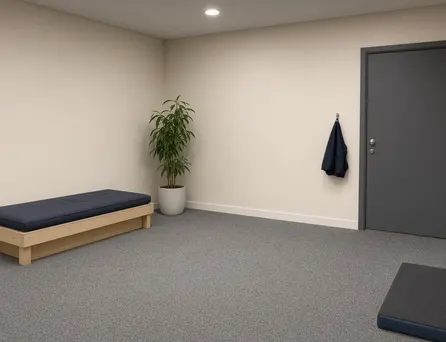
The stage manager assigns a quiet room before the dog arrives, checks its route from the stage with the handler, and tells the cast that entry and interaction require the handler's invitation. The dog must be able to retreat with its handler rather than be sent away as punishment.
Walking the Path Offstage
Position the quiet room away from speakers and scene-change traffic. Use a freestanding visual barrier at its entrance without obstructing ventilation or the exit. Add soft furnishings or portable acoustic panels outside the dog's reach.
Hearing the Room at Full Volume
Then check the room during the loudest planned music cue rather than judging it while the studio is silent. A quiet studio will flatter the design. The cue will tell the truth.
Handler Invitation Only
The quiet-room doorway is a boundary for the whole company: no actor visits a resting dog without the handler's invitation, even between scenes.
Drawing on veterinary guidelines on animal welfare, rest and retreat sit inside the same plan as the number itself.
Separating Harmonies From Handler Passes
A supported ensemble gives the house the unforced warmth an adoption musical promises. A stressed one gives it a taut leash and a smile that never reaches the eyes.
Rehearse vocal phrasing, emotional beats, and partner reactions while the dog rests. When it returns, the cast can respond to what the dog actually does. The actor is free to sing. The handler is free to watch the animal. Nobody is asked to hold a harmony, a leash, and a missed entrance at once.
The stage manager can separate a music-only pass from a dog-and-handler pass on the call sheet, so a difficult harmony does not trigger another animal entrance. After each dog-and-handler pass, record observable cues such as a voluntary approach, hesitation at an entrance, or a request to leave, instead of rating the dog as cooperative or uncooperative.
Audiences feel the current between cast and canine. They came for the bond. Compassionate pacing is how that bond survives the work, and how a heartwarming beat stays true when the lights are up.
Score The Rest
Break the adoption-musical rehearsal into music-only passes, handler-approved dog entrances, and a cast-ready version that can proceed without the dog.
Approve the Dog-Free Version First
Directors must leave room for a rescue dog to end a rehearsal early. Write it into the schedule. Defend it in the room.
The artistic integrity of a pet adoption musical relies entirely on the ethical treatment of its subjects. Approve a version of each dog-dependent scene that can continue if the handler ends participation. Schedule that version before technical rehearsal. That order protects the animal's exit and the cast's ability to finish the performance.
A fallback can transfer the dog's intended cue to an actor's line or a musical transition, with the stage manager calling the change. Reserve a 5–10 minute flexible slot around dog-dependent work for resets or an early finish, rather than filling every gap with another pass. Treat the slot as production-planning time.
Give the minutes to the dog. Those minutes buy back the hours that corrective behavioral work would have taken. Put the welfare-led call sheet on the wall and run the show from that document.